Video SEO: What 100+ Podcast Interviews Taught Me About Getting Your Videos Found
Everyone tells you to "do more video." Shoot more Reels, start a YouTube channel, put a video on the homepage. Well, the truth is that most business video is i…

Everyone tells you to "do more video." Shoot more Reels, start a YouTube channel, put a video on the homepage. Well, the truth is that most business video is invisible. It gets uploaded once, picks up a few dozen views, and never does a single thing for your website.
I've interviewed more than 100 marketers, SEOs, and business owners on the Unscripted podcasts, and video kept coming up, whether I asked about it or not. The people getting results from video weren't the ones with the best cameras. They were the ones who understood how video actually gets found. Here's what they taught me.
What Video SEO Actually Is
Video SEO is the work of getting your videos found by the right people: in YouTube search, in Google's video results, in AI answers, and on your own website, where a viewer can become a lead.
Google's own video SEO best practices cover the technical side. You need a page where the video is the main thing, structured data that describes it, a video sitemap, and a thumbnail Google can fetch. That's all useful, and you should do it. But the documentation is a little too tidy. It explains how Google indexes a video. It doesn't tell you why anyone would watch it, or what happens after they do.
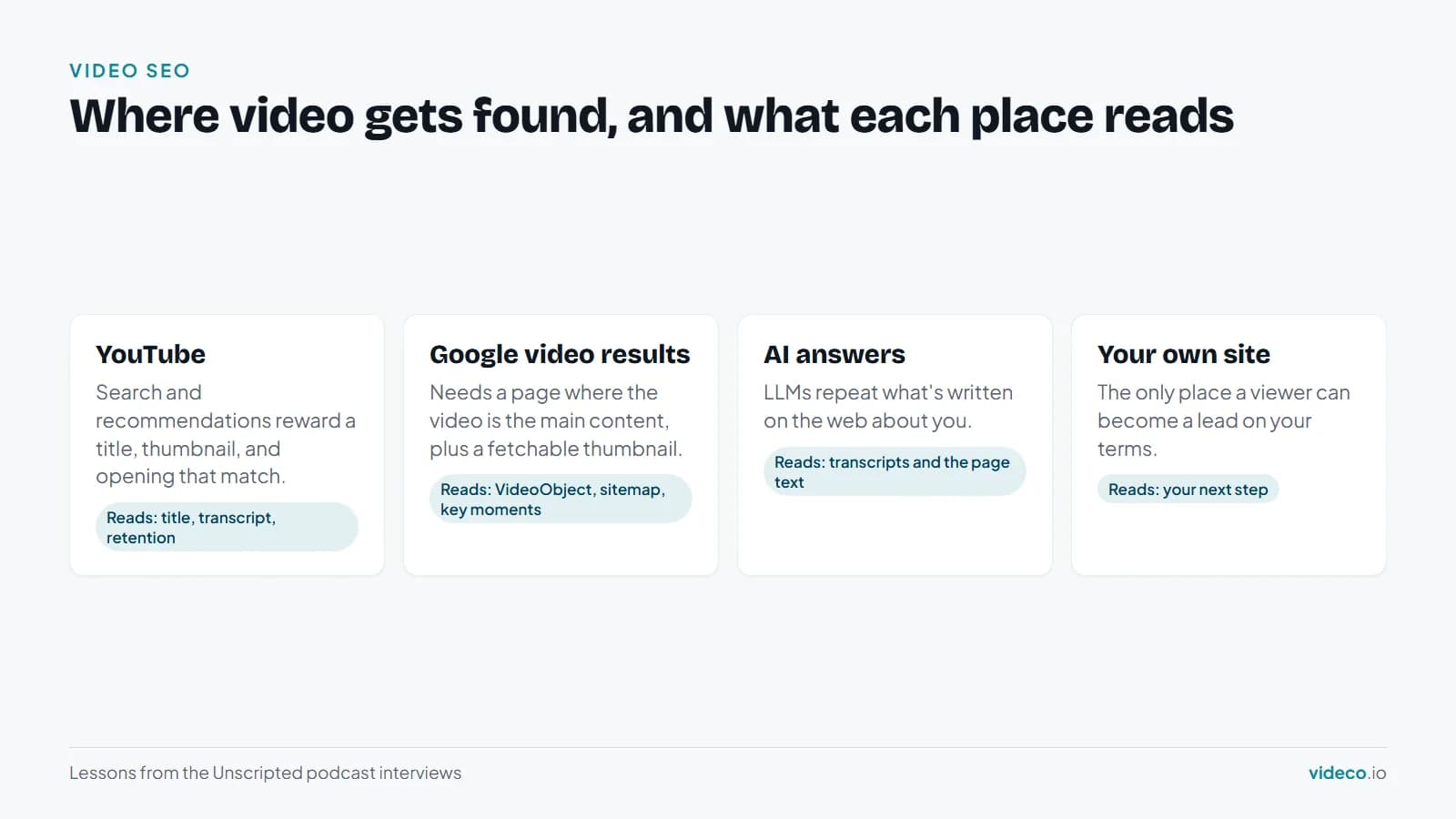
So think of video SEO as three jobs:
Get found. Titles, transcripts, structured data, and a real home on your site.
Get watched. A hook that keeps the promise your title made.
Get the next step. A clear way to book, buy, or reach out once the video earned some trust.
Most businesses only work on the first one, and then wonder why video "doesn't work."
Transcripts Are the Part Search Engines Actually Read
Search engines and AI tools can't watch your video the way a person does. What they can read is the words. Bridget Willard put it simply when she was on the show: "SEO is words, and words are SEO." Her advice to clients was to get on YouTube if they could, because "transcripts are gold."
She took it one step further when we talked about AI search. Large language models still only know what's on the internet, so you might as well feed them the version of your expertise that you want them to repeat. A transcript is exactly that.
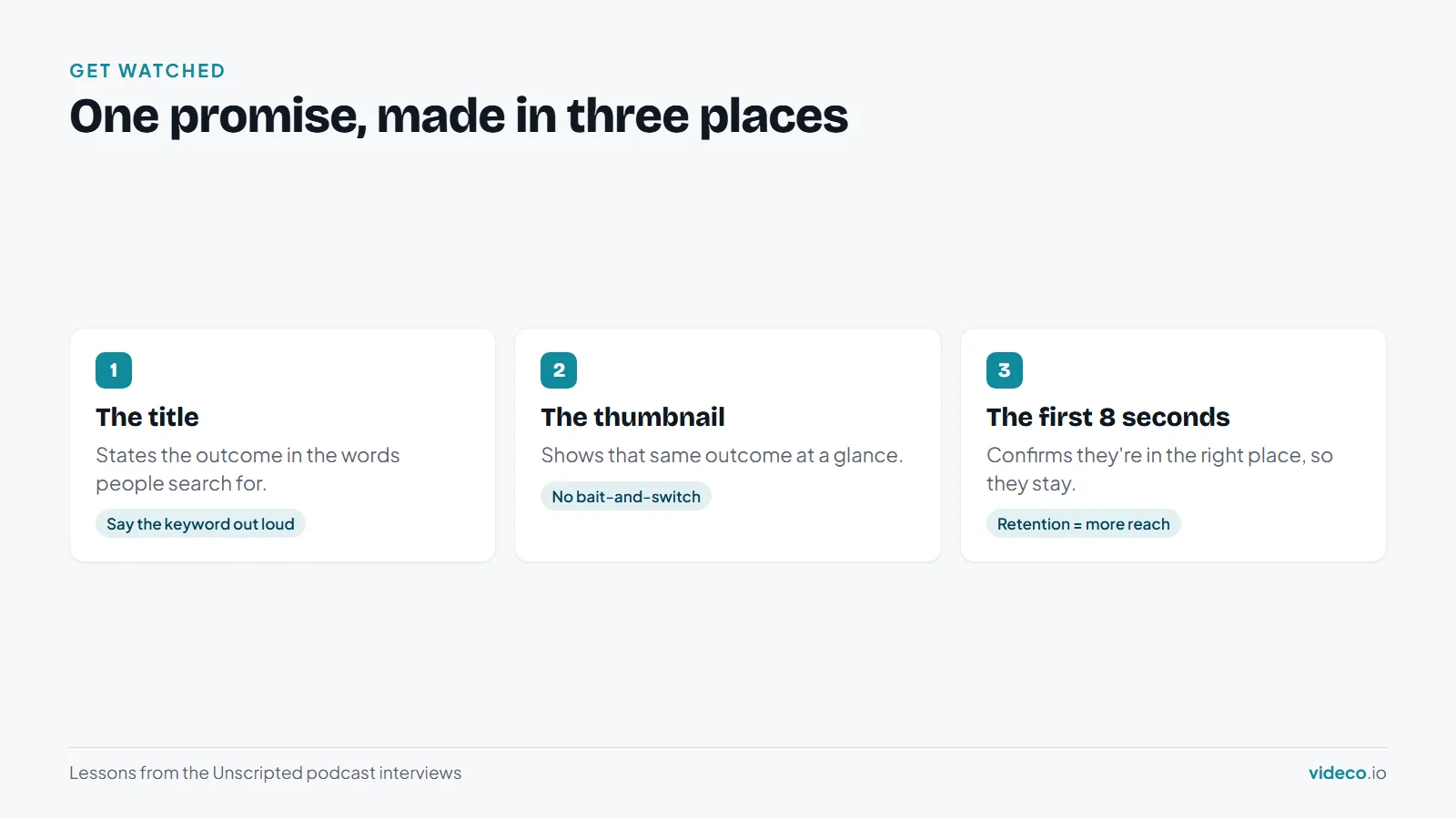
Joe Zeplin, who left a corporate job to go full-time on YouTube, plans for this on purpose. He packs his video's promise into the first eight seconds, and he makes sure the key phrases are words people search for. In his words: "when YouTube takes the transcript, it's more likely to recommend my stuff."
Here's what that means for you:
Say your keywords out loud. Don't just put "video SEO tips" in the title. Say it in the first few seconds.
Publish the transcript on a page you own. Clean it up, add headers, and post it under the video. Now the page has words for Google and the video has context.
Add chapters. Timestamped chapters give viewers a way to jump around, and they give Google a way to show key moments in search results.
When I talked with Joe, I pointed to research from Lily Ray and Mark Williams-Cook showing AI tools citing YouTube videos more often. That trend only helps you if your videos are full of the exact words people are asking about.
Your Title, Thumbnail, and First Eight Seconds Make One Promise
Getting clicked is only half the job. If the video doesn't deliver what the title promised, people leave, and the platform stops showing it.
Joe described it bluntly. If someone clicks a video titled "how to schedule a social media post" and you're doing anything but showing them how, "they're gonna drop off right away. And that's gonna hurt retention, and then YouTube's not gonna promote that video."
Tom Marriott, "The SEO Punk," made the same point about short-form. His own content has gotten rawer, and production quality matters far less than it used to, but the hook still isn't optional. "You have to say something in the first two seconds that makes people think 'what does this person mean?' rather than scroll past."
And if you're the business owner who hates being on camera? Matthew Slaymaker had a practical answer: maybe there's an employee who's more comfortable on camera, or someone who can interview you and tee you up with questions. You don't have to be the star. Somebody does have to say something worth staying for.
Show the Work
This was the lesson that changed how I think about video for "boring" businesses.
Melanie Whittaker of You Are Your Marketing told me that every business, big or small, needs videos of the work being done. The crew doesn't need to be full of personality. They need to show what they do. Her example was a leak repair: if you saw a video of the team explaining how they put a property right after water damage, "you'd be like, oh my God, these guys know what they're doing."
Erica D'Arcangelo, who co-owns a video production company, has the numbers to back it up. One of their simplest videos, people cutting pizza, has 64 million views. Nobody would have guessed that. Simple things done right, filmed plainly, find an audience.
I've seen this play out with my own clients. When I worked with a company that makes precast concrete walls in Florida, I didn't just interview the VP. I sat down with the guy who oversees installation on site. One question, "what keeps you from getting these installed?", turned into a whole content plan: how much land the crane needs next to the wall, what the truck needs to get in, and the feature buyers ask about most, keeping people from digging under the wall. None of that was on their website. All of it was sitting in one recorded conversation.
That's the concept: one honest recording of someone who does the work, and you have a video, a transcript full of real buyer questions, and the raw material for every page that follows.
Melanie also had a rule for what comes after the video. End it with the next step: now that you've seen how we do this, if it's what you're looking for, click the link and book a call. As she put it, "your website has to do the heavy lifting. The videos need to do the talking."
Don't Let YouTube Be the Only Place Your Video Lives
YouTube is a search engine, and you should be there. But most people who create video don't actually use it well on their own website. That's the gap I see most often.
When I talked with Joe about this, I described the way I'd handle a single half-hour video:
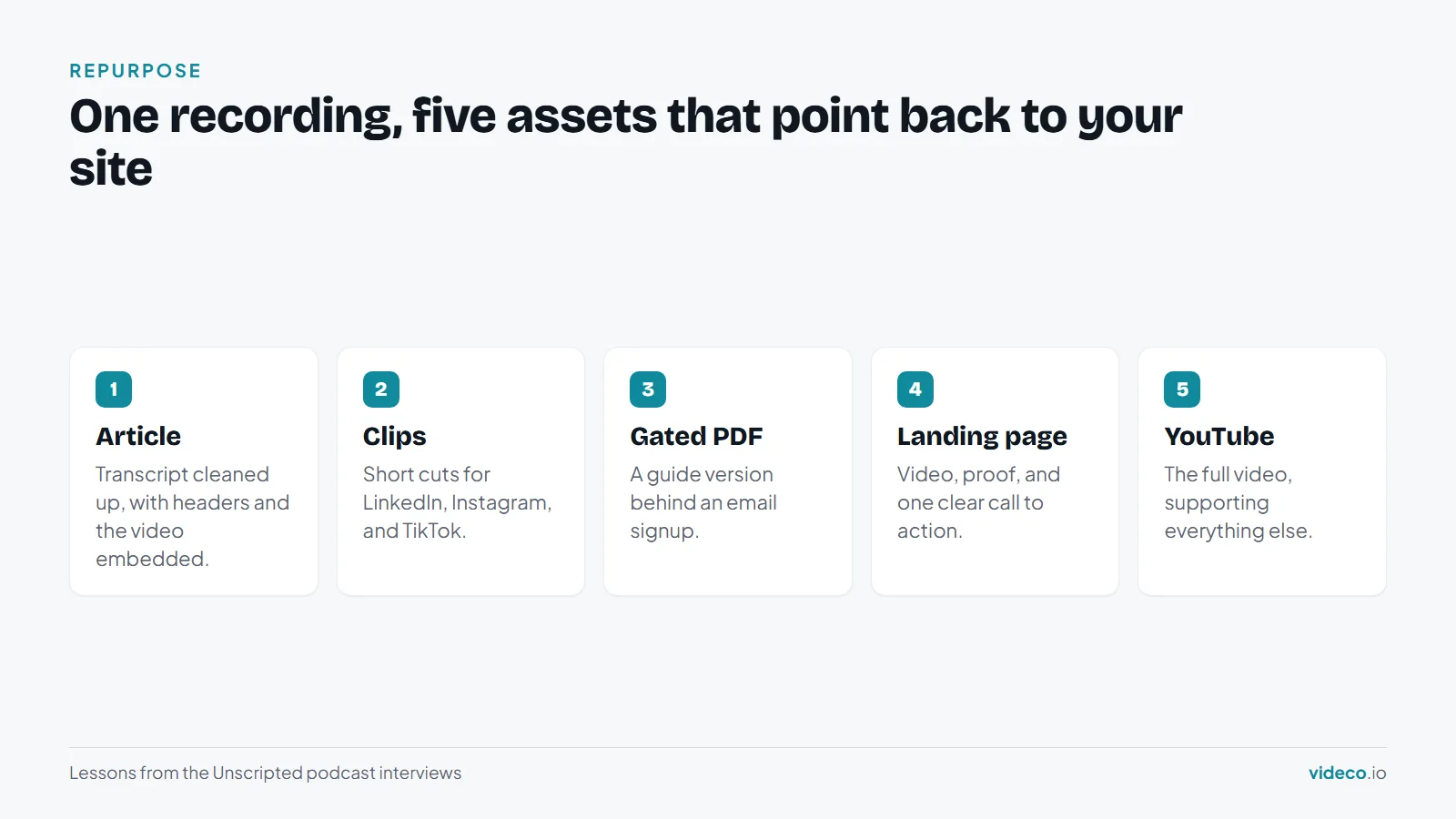
Turn the transcript into an article on your own site, with headers and the video embedded at the top.
Cut short clips for LinkedIn, Instagram, and TikTok. Videco's guide to turning long video into LinkedIn clips walks through it.
Gate a PDF or guide version behind an email signup.
Build a video landing page for the offer, so the video, the proof, and the call to action live on one page.
Keep the full video on YouTube, where it supports everything else and can be discovered on its own.
That's at least four or five pieces of content from one recording, and every one of them points back to a site you control. Where you host the video matters here too. Videco's comparison of YouTube, Vimeo, and dedicated video hosting covers the trade-offs between reach and control. If you're recording webinars, their guide to what to do with a webinar recording after the event applies the same thinking.
Melanie had one more warning that belongs here: "It's far better to do less and well than everything and it's crap." You don't need five channels on day one. You need one recording you're proud of and a page it can call home.
A Video SEO Checklist You Can Actually Use
Before you publish your next video, run through this:
One clear search phrase in the title, said out loud in the first few seconds
A thumbnail and opening that deliver exactly what the title promised
A cleaned-up transcript published on your own page, with headers
Chapters with timestamps for anything longer than a few minutes
A dedicated page on your site where the video is the main content, with VideoObject structured data and a video sitemap entry
A next step at the end of the video and on the page: book, buy, or reach out
Clips cut from the long version for the social platforms your buyers use
So here's what I'd leave you with. What's the one job your team does every week that your buyers have never actually seen? Who on your crew could explain it in two minutes? And when that video gets found, where does it send people?
Answer those, and you're doing video SEO.